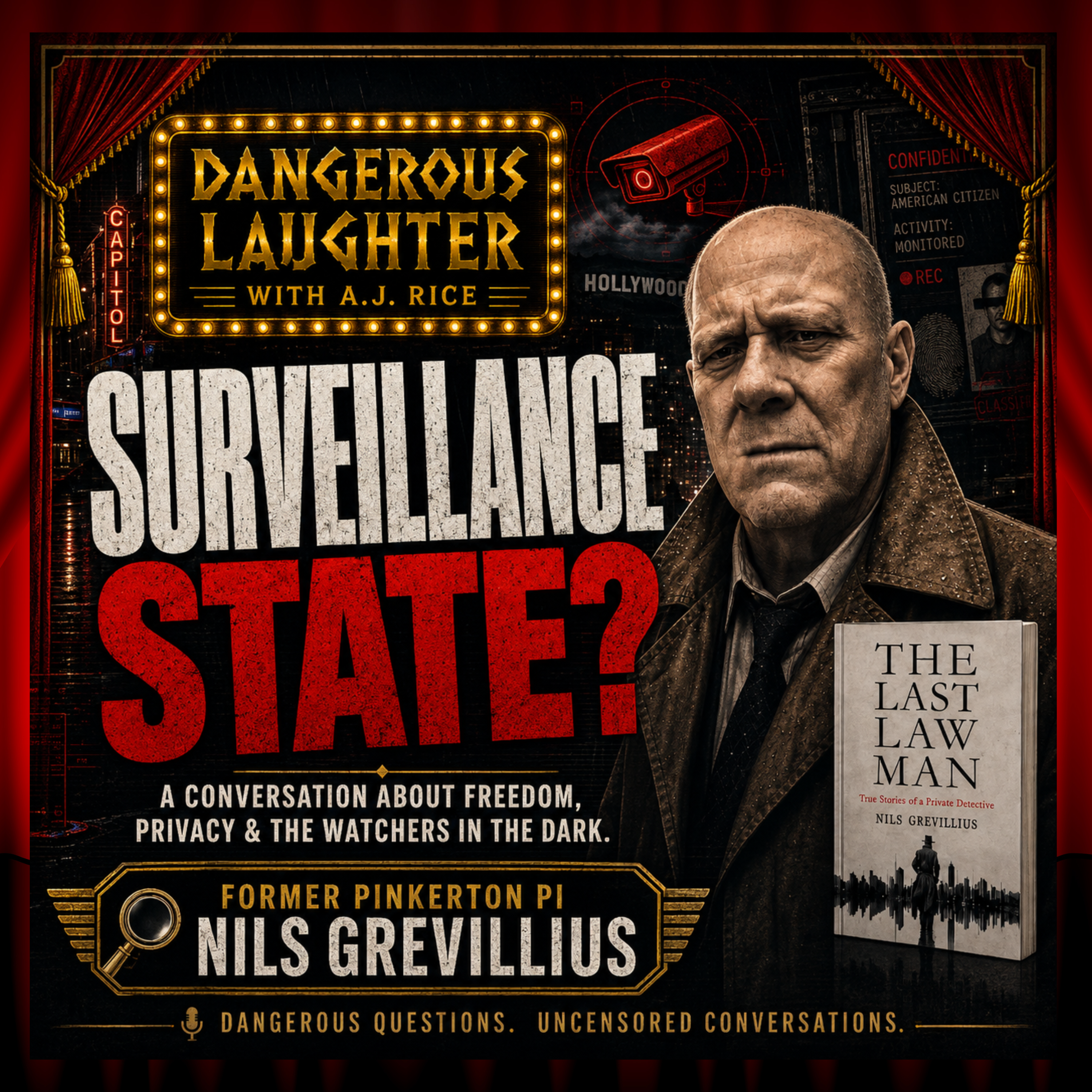
Episode Transcript
[00:00:01] Speaker A: Dangerous Laughter. Laughter.
Dangerous.
Dangerous Laughter.
Dangerous Laughter.
Danger.
[00:00:25] Speaker B: Laughter.
[00:00:27] Speaker A: Sam.
[00:01:09] Speaker C: The emergency destruct system is now activated.
The option to override detonation procedure has now expired.
The ship will automatically destruction.
And welcome back to Dangerous laughter. I am AJ Rice. Remember, go to dangerouslaughter.com Our job here is to transform horror into humor.
And look, comedy is our civic duty. Some days we're dangerous. Some days we're having fun, we're laughing. Some days we're doing a little bit of both. You know, I've got a. An amazing guest for you today.
You know, sometimes I get to interview my own clients here. I run Publius pr.
I am the goat. I have scalped most of my competition.
Don't need a private investigators sort of snooping around in that, looking for the scalps.
But every once in a while, you know, you can't love all of your clients, and not all your clients get to be interesting. But today, I've got someone special for you. I just want to weigh in on one thing before I. Before I begin. You know, getting a lot of messages about how MAGA, or America first has become the establishment. It's become the establishment. Now, how did that happen?
We got rid of Baner. We got rid of Paul Ryan. We got rid of Mitch McConnell. We got rid of the goons, the Ivy League idiot goons at the RNC.
So MAGA became the establishment. Well, this journey began 10 years ago.
Wasn't that the point? Wasn't it the point to become the establishment, you dummies.
What a bunch of. I'm leaving the Republican Party. I. A giant dummy.
A lot of stupid people out there. A lot of people running around, you know, like Puritans in New England, trying to administer purity tests, looking for witches to throw in the water to see if they float.
Dumbasses. Yeah, we're the establishment. We won.
Don't be a sore winner and don't run around like you're, you know, Rose Pierre trying to perpetuate a continuing, you know, counter revolution.
Enjoy this moment. I'd say this to all Trump voters, not the 7% that are all upset. Oh, we became the establishment. We won.
I'm mad about this little issue and that little issue. I love the mulas.
You know, we interviewed the Mullers.
We interviewed the gay Atolla should go on rumble.
Check that out. It was an exclusive interview with the gay Atolla. We had fun with the gay Atolla. You know, he told me what his favorite Meg Ryan Tom Hanks movie was.
So let me bring you to my guest here. My next dangerous guest is a private dick versus a public dick.
Like your host here. I'm a public dick. He has spent 30 years finding people who don't want to be found.
Crimes people wanted buried.
He's been a soldier. He's been a counterintelligence officer, a Pinkerton investigator, and now he's finally telling the stories that usually stay locked in the case file. He's author of the new book the Last Lawman, True Stories of a Private Detective. Ladies and gentlemen, the man I have following all 14 of my ex wives, Nils Gralius. Everybody.
Welcome. Welcome, my friend. Welcome. Is.
[00:05:04] Speaker A: Is anybody going to ask the question, which of your 14 ex wives I'm taking horizontal liberties with?
[00:05:13] Speaker C: Well, seven of them will definitely give it to you for like under 50 cents. So, you know, you know, they're. They're easy ride, but you're not. You're gonna have to come off that wallet for the other seven.
Look, everybody go out there, get a copy of this book. This is Neil's book. I mean this, It's a great book. No, yeah. I mean, look, the 14, they're not all, you know, beauties in the. But most are in the right light.
So if you're doing a little horizontal, as long as the lights are out, you'll be fine.
[00:05:42] Speaker A: Well, I gave up on strong drinks some years ago, so no longer do I get trapped in a situation where I find a bunch of gnawed off arms under a woman's bed.
Now, Mr. Rice, a point of clarification. I was never a counterintelligence officer. I was a counterintelligence agent.
I wasn't good to be an officer. I, you know, I could barely get a ged.
[00:06:08] Speaker C: Did I say officer or operative? Because I wrote operative, but I might have said officer.
[00:06:13] Speaker A: That's okay. It's all right. I just don't want one of the eggheads that I used to work with claim that I am purporting to have been an officer.
[00:06:22] Speaker C: Sure. We don't want any stolen valor from the dorks.
[00:06:25] Speaker A: Well, I worked for a living. And that's the point of clarification. Within the ranks of the military. It's a joke. If you call the sergeant sir in the army, he will get in your face and say something funny like, I work for a living. Never call me sir.
[00:06:39] Speaker C: That's right. That's right. We'll have to. We'll rewind, we'll get the Wayback Machine and see what's okay.
[00:06:43] Speaker A: It's all right, man. We're good.
[00:06:45] Speaker C: So, Niels this is a hell of a name. Niels Grevilleus.
I think the audience wants to know. So you're, you've been a private investigator. You've been in this world for 30 or 40 years and you've done all these things. A counter intelligence agent, Pinkerton investigator.
You were a soldier.
So what is the Niels Grevilleus origin story?
We want to know the origin story. All great, listen to me. All great characters. Character driven dramas, even superheroes that have some great characters, they're not all great, some of them are dog shit. But we want to know the origin story. I think the audience deserves that.
You are a character. You're one of my favorite clients I've ever had.
Lay it on us.
[00:07:38] Speaker A: Well, I was born to ruling class progressives. My father was at the New York Times when I was born. My mother was part of the Canadian American industrial aristocracy.
I was supposed to take an Ivy League degree and hyphenate my last name and strap on some Birkenstocks and maybe go file some lawsuits and, and get paid off in, in soy burgers or something like that.
I couldn't drop out fast enough. Aga. If I could have gone in the army at 13, I would have.
[00:08:10] Speaker C: Sure. And what age was that?
It was seven.
[00:08:14] Speaker A: But the old man signed the papers. He laughed at me. He was a marine corps veteran of two wars. He signed the papers. And back then progressives actually did serve in the military and in a meaningful function. He was a grunt in Korea and was hosing Japanese out of the caves in the Pacific in the late 40s. I mean they still had Japanese in the Gilberts and Marshall Islands. And so that's what he was doing.
So he laughed at me. He signed the papers and he says the army is a chicken outfit, but they're tougher than you. You'll be begging me to come home in two weeks. So I stayed gone for seven years.
Wow.
[00:08:53] Speaker C: So, and you are right about that.
The, the Democrat party or progressives, I guess they did used to produce warriors.
They did produce people that love the country enough to go serve and from. You know, every once in a while we still get someone like that. Sometimes in, in the modern era it's somebody that wants to be able to point to that in the future because when they wake up in the morning, you know, they, they see the president staring back at them or they see a governor or a U. S. Senator. So they're, they're playing the resume game. But that's not what you were doing. Why did you go do this well,
[00:09:37] Speaker A: okay, so I didn't do well in, in high school. I, I couldn't, I couldn't be bothered. At a certain point, I gave up. And my last report card was three A's and three F's. You know, a perfect 2.0 average.
[00:09:51] Speaker C: Sure.
[00:09:52] Speaker A: My mother was as mad as hell. My mother's, she's dead now. She was a criminal lawyer.
She went to Sweet Briar. You know, grew up in, in Albany. You know her, her grandfather, the New York State Commissioner of Transportation.
Her great grandfather was our ambassador to Leopold II of Belgium. All of these things, right?
Do that stuff. I couldn't be less interested. Man, if I could have jumped out of airplanes and blown things up in kindergarten, I would have, I would look out the window. And here's the other fault that I have, A.J. i was terrible at sports, which is, is a coin of the realm when you're a kid.
[00:10:32] Speaker C: Sure.
[00:10:33] Speaker A: I never quit. So in junior high school I just said, to hell with it. I'm going to go out for every sport. And I'm trying to, I'm going to try to master every one of them. And that was my self improvement project. Was barely making it onto the baseball team, the football team, the track and field team. And in high school I lettered in track and field and I was a terrible athlete, but it made me into a tougher, stronger man and made me more agile, faster, that sort of thing. And in the army, I started as a. As a scout.
I was supposed to be a cavalry scout, but I was always in infantry units, which I don't object to. A lot of cavalrymen like to look down on the infantry. They're the most arrogant motherfuckers in the world. But it's okay. It was good. I got way more out of that experience than they extracted from me somehow.
I worked in the DMZ in Korea.
I took to Korea like a pig to warm mud after a while. And then I eventually got recruited to counterintelligence after they sealed my juvenile criminal record and I got a GED and that sort of thing. And I did very well in the testing and the academics of counterintelligence.
But I'm not a good fit with the tattletales and the goody two shoes who like to populate counterintelligence rather than run counterintelligence operations.
You can look up an anodyne description of what a counterintelligence agent does, and it has to do with interdicting the collection efforts of hostile intelligence services or non state actors. Well, When I was in counterintelligence, there were a lot of guys who thought Korea was a backwater, a meaningless assignment. They wanted to be Field Station Augsburg, field Station Berlin.
They wanted to read Le Carre novels and smoke pipes and, you know, plate gas and that sort of thing. And they didn't want the counterterrorism mission. To me, it looked like the Cold War was ending and that terrorism, particularly Islamic terrorism, would start to be a problem.
And the Red and Green alliance was obvious even then, that the hard left would slither.
[00:12:52] Speaker C: This. What year is this, if I may,
[00:12:54] Speaker A: that you're seeing this, like, 85, 86, 87. I'm seeing the hard left start to warm up to the jihad. And indeed, when they love the.
[00:13:06] Speaker C: They love the Iranian revolution, they love that. They love the Marine Corps barracks bombing in Beirut. They love the Ail Lauro attack, the Lockerbie attack. They. They cheered it. This, you know, seeing these wackos in the streets Today in the 21st century, there's nothing new because totalitarians of a feather flock together. Isn't that right, Niels?
[00:13:28] Speaker A: Well, that's true. And the Ayatollah Khomeini, give him credit. He used Lenin's tactics to motivate the Iranian middle class to overthrow the Shah.
And the Iranian middle class, just like the Cuban middle class, immediately came to some rocks and shoals of reality with this and had to flee the country that they had overthrown the government in. But the hard left in America and in the west did support and cheer for the Ayatollah. They were happy to throw Jimmy Carter overboard. He wasn't. He wasn't hardcore enough for them. So, you know, Carter's sins are many and perfectly enumerated elsewhere. But in 1993, when Abdel Rahman bombed the World Trade center in 1993, okay, so his attorneys were communists. They were all from the National Lawyers Guild. Lynn Stewart, who later took a bullet for him, went to federal prison and got disbarred for bringing his communiques out to his followers. Okay, so Bill Clinton did his part by treating Islamic terrorism like a criminal problem rather than a national security problem. He didn't want to risk any of his political capital by going into Congress and saying, we've got a real problem here and we better send Delta Devgru, all those guys and take care of this problem. And it just festered and metastasized and whatever else. And Bush was conflicted to the extent that he didn't want to bring oil production home.
His family grew up supporting the 8,000 mile supply chain in the Middle East. And his greatest concern was how to protect that supply chain rather than doing any heavy lifting in America after, after 9, 11. What Bush should have been doing was enacting a gra, a draft to make the burden of service broadly shared, selling war bonds and domesticating our oil supply so we're no longer vulnerable to these bastards. Bin Laden's tactic in attacking us wasn't to overthrow the United States immediately.
It was to overthrow any regime within the Gulf of Petroleum friendly to us. So one more time that that supply chain made us vulnerable to an attack.
[00:15:54] Speaker C: That's right, you're right.
And you know, we go back through the timeline there especially, I think there was a kumbaya era of good feeling when the Berlin Wall comes down and you know, Bush senior and Schwarzkopf remove Saddam from Kuwait and Bill Clinton, you know, he wins the first baby boomer president.
You know, he's jogging, he's jogging through Rock Creek park with his little short shorts on. He's, he's running through the drive through at McDonald's. He's doing the disappearing cigar trick in the Oval Office with Monica. He really couldn't be bothered. He couldn't put those pieces together.
Whether it's the Cobar towers attack or the USS Cole or, you know, Ramsey Youssef's bomb. You know, and I've discussed this recently with another guest of ours, Mark Rossini, FBI direct FBI guy that was on the case.
You know, he, he didn't want to piece these things together. And anytime something would happen like the embassy attacks in Africa, he would do a little, you know, kinetic movement and then be done with it and get back to the bongos. He was playing well.
[00:17:03] Speaker A: And he also had yes men in the military. Wesley Clark was a creature of the Clinton crime machine.
Wesley Clark's claim to fame was he was number one in his class at West Point. Well, in the United States Army, Wesley Clark has a reputation for stepping on everyone he needs to step on to get ahead.
Thank God Wesley Clark didn't recoin himself as a Republican and run for president in 2000.
[00:17:30] Speaker C: He thought about it for like five seconds. Remember?
[00:17:33] Speaker A: Yeah, you know, the button down GOP would have said, oh my goodness, let's take Wesley Clark
[00:17:40] Speaker C: jump in the race.
In the 04 race with Dean and Howard Dean and John Kerry were in. I think he jumped for like 15 seconds. He was in that race.
[00:17:50] Speaker A: I think he was in the 08 race between, briefly between broom pilot and baby Lord Husseino. But I mean it's all kind of a blur. There was kind of a smorgasbord of delightful Democrats in 2008.
[00:18:05] Speaker C: So let's get back to a little bit about your origin here. I don't get too far afield there, but, you know, so you come from this progressive family, and the, the question is, and your father's a Marine.
Did they get to see.
I mean, I don't know when they passed, but did they get to see you go through all the different things you went through from the army to the Pinkertons? And we're going to talk about what the Pinkertons are, you know, in. In the next segment, because we'll take a break here in a second. Did they get to see what you became and, and. And, you know, owning your own business, own your own private detective business. What was their thoughts on the. The fruit from the tree?
[00:18:51] Speaker A: My father did not get to see me ultimately putting together my own show. He saw me taking jobs afield after the army, working for the civilians going into the Pinkertons.
Being a. A pro labor guy, he thought the Pinkertons were just garbage, the lowest in the world. But.
So I'm working an industrial undercover job as a Pinkerton man. And he paged me.
This was about two months before he died. And there was this brilliant article in a newspaper no longer extant, called the Los Angeles Herald examiner. And in the front page of the business section was this expositive on Los Angeles private investigators and how many of them made more than $100,000 in a year, which in 1989 was, you know, adequate pay.
And he. He said to me, you know, you may be onto something. You. Maybe you'd want to go into business for yourself and I could be your partner. Now, the old man did infiltrate KKK groups in Arkansas during the forced integration of the Little Rock public schools. His lover at the time was Daisy Bates, head of the Arkansas naacp. And he fled to New York and got his job at the New York Times after becoming too hot a property in the Deep south, which, you know, that was the end of his relationship with Ms. Bates, a very respectable character of the civil rights era. She risked her life, he risked his life, that sort of thing. So he had some bona fides in investigative work. Sure.
[00:20:28] Speaker C: That in and of itself, I mean, that's a story in and of itself. I mean, that. I mean, look, guys like you, Nails, we're going to take a break here, you know, and. And look, I've. I've exp. I've.
I have all kinds of stories they're different than yours. But when we have an author like you, you know, it's not. It's never a straight line. And these stories are, you know, great stories and great sort of origin stories are built on that type of high drama. So we're going to take a break here. I am AJ Rice. This is Dangerous Laughter. Remember, enlightenment begins when authority becomes laughable. We're gonna have some laughs on the other side of the break. We will be right back.
[00:21:12] Speaker B: Yo, yo, yo the chamber like a daycare Toys all scattered Democrats throwing tantrums Egos all battered Popcorn flying out Greens the mix booted out the union like a bad magic trick Crying, whining, can't keep it low Nancy holding tricks, trying not to explode Chewing on her tongue Silence, a weapon a circus in the capital A lesson on step it in, step it in, step it in.
Alphabet soup the DNC's a mess juvenile antics, no adult finesse Chucky in the corner scheming with a grin Politics a playground Let the chaos begin Al Green serenades but they mute the tune Ejected from the floor by the afternoon tug of war Politics, truth lost in the fray Pelosi's tongue acrobatic steal the play Congress acting up, no teacher in sight Time keeps ticking but ain't making it right Throwing fits, paper planes in the air this democracy looks more like daycare Our family here at Dangerous Laughter has a new mission. After 250 years of American history, we
[00:22:24] Speaker C: seek to showcase moments of great statesmanship,
[00:22:27] Speaker B: moments of courage, moments of restraint and uncommon wisdom.
[00:22:31] Speaker C: Moments of Maxine Waters
[00:22:35] Speaker B: that we stood up, that we pushed back, that we thought that we did not consider ourselves victims of this president. You have members of your cabinet that are being booed out of restaurants.
She's picking up at their house and saying, no sleep, no piss, no sleep. And if you see anybody from that cabinet in a restaurant, in a department store, at a gasoline station, you get out and you call a crowd and you go back on them. And you, the management of this station, are clueless.
You're listening to Dangerous Laughter with AJ Rice on the Publius Media Network
[00:23:23] Speaker C: and we are back on the DL. Our job here is to transform horror into humor. This is Dangerous Laughter. I've got Nils Gravalius with us. Grevilleus. Everybody gotta go get his book, get out there. Gotta help pay for that Bezos wedding.
So we're talking to one of my favorite clients, a brilliant guy, a guy that they brought the mold on. You know, I don't. I'm not sure Gen Z and Gen Alpha is going to be able to produce guys like Niels Neil's.
Most people. This is a. The Pinkerton organization, Pinkerton Group, Investigative Group.
These are alleged. This is a legendary group.
People that. People that watch westerns or, you know, 19th century films or TV shows might hear this word in the background. They might hear this name in the background.
But just for the, for the audience sake, you worked for them. Just give us a brief history on who they were and how you ended up with them.
[00:24:29] Speaker A: Early 1850s, Alan Pinkerton, a labor activist and school teacher from Glasgow, Scotland, fled to the United States and landed in Chicago. And got one look around at Chicago and realized that that city was in deep kimchi.
So he. He was told, you may not do this. You must not do this. You don't know what you're doing. You're not a professional. We're trained professionals, blah, blah, blah, blah, blah. And he went into business for himself as a detective to protect institutions, businesses, trusts, people, even government agencies. He protected Abraham Lincoln all during the Civil War.
[00:25:10] Speaker C: That's right.
[00:25:10] Speaker A: He hired men and women. He established secret methods of communication, of infiltration. He infiltrated the Molly Maguires and the Pennsylvania coal fields in the 1880s. He.
He infiltrated the Western Federation of Miners, which was a wobblies organization meaning early proto communists contemporaneous with their assassination of the governor of Idaho, Frank Steunenberg, in 1906.
He arrested.
He had Charlie Soringo arrest Big Bill Haywood and haul him to Boise for travel. Haywood got defended by no less an eminence than Darrow. Clarence Darrow got him acquitted.
And then Siringo went out and stood down the lynch mob that gathered after the acquittal. You know, Siringo was born, is buried in Morningside Cemetery in inglewood, died in 1928. The man survived everything. He was a cowboy for 20 years before he ever became a pri. A detective, let's just say detect. There were no detectives in the 19th century. The detectives were all private operators. And if you think, if you want a modern analogy, Alan Pinkerton was running something like black water from 1854 up until the 1920s when things started to change. When the FBI was formed, there wouldn't have been an FBI in the form that it's known now, nor a Secret Service without Alan Pinkerton.
[00:26:44] Speaker C: So it was kind of like Eric Prince at Blackwater, who I know.
And then, you know, after the Lincoln assassination, I guess with Grant, the Secret Service was formed, right?
[00:26:55] Speaker A: That is correct. The army took over protecting Lincoln and Pinkerton had suppressed at least two assassination attempts on Lincoln.
[00:27:05] Speaker C: Where was the night of the Ford Theater assassination?
[00:27:09] Speaker A: I beg pardon?
[00:27:11] Speaker C: Where was Pinkerton the night of the assassination of President Lincoln?
[00:27:14] Speaker A: I believe he was in Chicago, where the Pinkertons had been taken off the job. And the army was supposed to be protecting President Lincoln. And there are revisionists who love to gainsay Allan Pinkerton and claim that he made up the work, that he did, that sort of thing. That's just because they're envious. They wish that they had come up with this whole idea. Or they hate the idea of a private operator doing what government, holy government. Is supposed to do and always fails to do. You're talking to a man whose family lost. You know, my sister and her husband lost their house in the Altadena fire. They did, in January of 25. They didn't get warning, they didn't get evacuation notice, anything. Without my nephew there to help them, they'd have perished in the fire. And the people running Los Angeles are very busy covering up their own poop. And the local media is furiously doing everything they can to drive their getaway car. Well, this is a. This is a continuous story. Often the private guy is going to do a better job than the public agency. Rick Caruso, the developer, has his own fire suppression team, and none of his properties burned in the Pacific Palisades. Now they're accusing him of being a billionaire fuckwit who, you know, is so greedy that his fire force can protect his properties. You know, things like that.
[00:28:38] Speaker C: Yeah, no, he didn't have a bunch of, you know, lesbians protecting his property. He had, you know, he didn't have a bunch of Jackie Robinson lesbian firefighters. Instead, he had professionals, privately funded, competent. That didn't fail upward. You know, it's just ridiculous. Let's talk a little bit of. Go ahead.
[00:28:57] Speaker A: I know, I know a few lesbian firefighters are pretty damn tough and good at what they do, but they are the exception rather than the rule. And they weren't hired because they were dykes. They were hired because they were damn good at what they do.
[00:29:08] Speaker C: And I've always said that, you know, if you're going to be a lesbian firefighter, that's fine, but you better be freaking Jackie Robinson, because if you're not.
[00:29:17] Speaker A: That's correct. That's correct.
[00:29:19] Speaker C: You're out of here. Let's talk a little bit about what you just focused on there. There's this space that exists, and we've seen it a lot in the Trump era, and you see it in Technicolor at the street level between law and justice.
Right. The space that exists. I believe that what you do lives between these, these spaces.
I mean, are you the busiest? Because we just talk about institutions failing.
LA has become kind of a hellscape. Are you at your busiest as a PI when institutions fail and they fail people.
[00:29:59] Speaker A: That's an adequate statement. The year that I took my license out from the state of California was the same year that the Democrat, the hard left, staged the Rodney King riots.
You know, so the, the businesses I was protecting in the garment district were all owned by immigrants actually from North Africa.
[00:30:19] Speaker C: Weren't there a bunch of Koreans on the roof with long guns too, protecting their.
[00:30:23] Speaker A: Well, that was, that was further west in the garment district. It was me and some Moroccan teenagers, the sons of the building owners, they went out there with trap shotguns that they had and we protected them. We didn't have to shoot anyone. We came damn close, that sort of thing to protect their entire investment. And these are immigrants, they're quote unquote, people of color. Colored people or whatever the left likes to say to meet the needs of the criminal class that the leftists were appeasing.
The people running the city were just going to let anything happen. They told Daryl Gates to stand down and allow the riots to occur. And then later went after Dale Gates for standing down.
[00:31:09] Speaker C: And look, you know, we saw this, you know, when the patron saint of Fentanyl, George Floyd, died.
You know, it's the black owned businesses that burn first. It's the Asian owned businesses that burn first. It's the bodegas that burn first. It's not the McMansion in the suburbs built by Toll Brothers that burns first. Right.
[00:31:32] Speaker A: Well, that is true. And the same people who would, who were standing by and cheering and gleefully calling the 92 riots, the 2020 riots, civil uprising, gloriously, peacefully, fiery. And all of this are the same ones who get the vapors and get up their necks about some guy prancing through the United States Capitol in a mink jock strap on January 6th?
[00:31:58] Speaker C: You're right. Imagine, you know, I. Look, full disclosure, you know, a lot of the J6 defendants, some of them have become authors, some of them were famous before they went in.
You know, we have represented them here at Publius pr. You're right. I mean if we, if we, if, if they just use the same defense that is used for George Floyd or you know, I can't breathe or the Ferguson things or Trayvon Martin nonsense, you know, that, that, you know, it, they maybe got, they Would have gotten off a little quicker.
So. So did you.
[00:32:34] Speaker A: Did you happen to notice that Nick Fuentes never got pinched on January 6? Somehow he was the only quote, unquote, conservative media figure not to get arrested on January 6, not to get prosecuted. Nothing. Never indicted. Could it be that Nick Fuentes was maybe taking some of that sweet SPLC money or ADL money?
[00:32:55] Speaker C: Well, it was being. Look, it was being washed through all kinds of people. You're not the first to raise that concern.
Fuentes. I'm not sure I'd call him a conservative media figure. I think he's more of a satirist, living in his own side.
[00:33:10] Speaker A: I think he's part of a left wing side op. That's what I think, A.J.
[00:33:14] Speaker C: okay, fair enough. Fair enough.
[00:33:16] Speaker A: And.
[00:33:16] Speaker C: And, you know, he's been confronted with that. You are right, though. You are right. They're kicking in grandma's door in Alaska. They're kicking in grandma. Just some woman, you know, elderly man in Tampa Bay. And certain people. You are absolutely correct. The, you know, the FBI that seated the crowd didn't come knocking for them.
So let me ask you this.
How often when somebody comes to your office and you got your foot on the desk and you got a bottle of stag burp. No, I'm joking.
You know, they.
There's a guy. There's a guy. You know, they. They knock on the foggy glass door and you open the door. I mean, how often is it that they have tried everything else in the system, everything else in the bureaucracy, Everything else, whether it's a local government, the lapd, whatever the hell it is, are you. Do you find yourself, you are the people's last resort? Or are there people that call someone like you first because they intrinsically don't even trust local law enforcement or the bureaucracy in whatever state they're in?
[00:34:27] Speaker A: Yes, I get it both ways.
People who have been cycled through the system and punished appropriately for their belief that their government is here to help them.
Sometimes the government does help them. Usually not. I can give you some examples. There's a crime that the U.S. attorney's office up until about a year ago, used to laughingly refer to as pig butchering, which is where some guy gets contacted on a personals ad, a phone app, whatever, by some hot, sexy honey who wants him to get married and this sort of thing. But before they get married, how about a $200,000 crypto investment right away and whatever.
So the guy goes and makes a complaint to the police. The police say it's not Our jurisdiction, it's the FBI. The FBI won't even take a report. So if they do take a report, it hits the desk at the supervising special agent who chuckles because he knows the US Attorney calls it pig butchering. The guy deserved to get robbed as far as I see.
[00:35:33] Speaker C: I. So, you know, if you get, you know, you got a honey badger, you get honey, honey potted by, by some scam, you know, somebody's, you know, catfishing you or whatever the hell it is, they just, you deserved it. You deserved it. Now, you know, imagine applying that logic to all kinds of crimes that the left does care about. Right? So let me ask you this then is because I know you've bumped up against organized crime is like who's more dangerous? The, the bureaucracy sort of incompetence or organized crime, like which, you know, who. Because who fails? Who fails the public worse like who's more dangerous between those two?
[00:36:16] Speaker A: The bureaucracy, obviously. And I, I'm going to say something that's radical. I have a radical idea. My radical idea, AJ is that incompetence and indifference are the most endemic, pernicious, damaging forms of civic corruption you could imagine.
[00:36:35] Speaker C: Well, I agree with you, I agree with you. And you see it on a state level, local level.
We had a president that was plugged into an extension cord for four years.
God knows who that the hell was actually running the country. It was a combination between the deep state and I guess the diaper changer. Dr. Jill.
[00:36:53] Speaker A: It was, I think it was Ben Rhodes and Valerie Jarrett and, and Jen Psaki. I don't think that cringe Jean Pierre had.
She didn't have the intellectual horsepower to do much, you know, God bless her. I mean, they used her as, they used her like a toilet seat and walked away.
[00:37:15] Speaker C: Sure. How much of your job boils down to you? Because obviously we've told your origin story, you know, we could spend all day on it. I mean, I'm fascinated by it.
How much of what you do and, and makes you good at this and this. There are great athletes that use that, use what I'm about to say. There are politicians that just have an instinct that you can't define.
But how much of your success as a private investigator boils down to your ability to understand human nature?
[00:37:56] Speaker A: Well, there are two things that have made me manage to survive and thrive a bit in a very hostile environment, high risk profession. And it's two things.
It's my, my ability to understand the subtext of what is going on, to be able to read between the lines often not always. Sometimes I get caught up short and it takes me a while to suss out what's really going on.
The more important thing, other than being able to reason and physical ability also has to be there, is the emotional toughness.
It is that quality that the Navy is looking for.
And the army, of course, when they put men through special warfare selection, they're not looking for physical toughness. You take any healthy man of the correct age, you can make him into the physical specimen, but if he lacks the emotional toughness, you can't breathe it into him. You can't create emotional toughness where it doesn't always exist.
Right.
[00:39:03] Speaker C: I agree with you. I agree with you. I mean, that's why, you know, you look at guys like Larry Bird or Michael Jordan, they were absolute killers. Reggie Jackson, Willie Mays, they were killers. And, you know, you look at certain athletes now, they're soft. And that isn't just in sports. That's in all kinds of things.
You know, and it's because the things that make us tough are being replaced by things that make us soft. A lot of it is just the digital nonsense. And the devices. These kids, we got, generations now.
You know, they're born during a time period where, you know, these iPhones and all the rest of it have existed.
[00:39:45] Speaker A: Aj, they're cyborgs.
[00:39:46] Speaker C: Sure.
[00:39:47] Speaker A: You take away the digital device, they're half. Half a human being.
[00:39:52] Speaker C: Let me ask you this.
I've been thinking about this because I've been in the room with, I think, people that I could feel evil.
I could feel a physical displacement taking place in front of me, and a spiritual one, but, like, tell the audience, because, look, we all got our ideas on what a private investigator is, right? It's Colombo, it's. It's Bosch. It's the Sherlock Holmes, whoever the hell it is.
What is the moment like for you when you realize that you're not dealing with a normal person, that instead, across from you in the room staring at you, maybe professionally lying to you, you're dealing with a full blown psychopath? Now, we throw around that word a lot, but in the grand scheme of. Of how many people actually are that? The same thing with the word narcissist.
You know, people are just selfish or whatever, but I'm talking about a stone cold psychopath. What is it like?
Is it a surprise or is it a slow build where you're like, okay, you know, is there a trail of breadcrumbs?
[00:41:06] Speaker A: There is always a trail of breadcrumbs. And it has to do with how they communicate. And a good detective does what the FBI calls profiling. Well, there's. Detectives have always profiled. And what profiling is, is looking at every aspect of the crime as an act of communication and learning to interpret the communication that that is being offered. Okay, so let's say I come upon a woman in the park who has been trussed up with her underwear, assaulted and strangled with her. With her underwear.
And her fingernails are broken, her fingers may be broken, her clothing is strewn around, and she's been posed in a particular way.
We're talking about a very hostile male who is inadequate in all ways unless he is exerting violence.
He was probably institutionalized at a relatively young age, so he is probably a repeat offender. If there are aspects to the crime scene and I don't want to. I'm getting a little macabre here for your civilian audience, I'm going to do it. Let's say I find her fecal matter around her mouth.
I'm going to know almost certainly that she has been sexually assaulted, sodomized, maybe post mortem by a man who's been to state or federal prison at least once. Probably state prison.
Okay.
Who has an intense hostility not just toward women, but toward normal society.
And by posing this woman in this way so that passersby are going to see her along the trail in the park, I am looking for a particular type of mail that is an example of crime scene communication, or as the FBI likes to call it, profiling.
[00:43:13] Speaker C: Sure.
[00:43:13] Speaker A: If I find a man in his office shot in the head twice with a.22 and the desk gone through and the filing cabinet gone through, and his phone gone, and I never find the phone again. I know that he was murdered by somebody he was doing business with.
It was an act of. It was a business decision. Whether he's organized crime himself or organized crime adjacent or his business associate is a psychopath. So I'm looking for someone he does business with who is a psychopath, who may or may not have been to prison before, but will have a history of offending and aggression and that sort of thing. The psychopath is bored by ordinary life and will be and will act out in ways, let's say he's in a business position, he's going to do every single thing he can to advantage himself and figuratively sit, slit the throats of people he competes with, that sort of thing. He will commit torts and other transgressions that endanger the business and try to absolve himself of it. He will refer to himself in the third person in the same way that he'll refer to his acts in the third person. And often I can identify this sort of person in a business setting by going through his personal communications.
Whether he was communicating about a crime or not, I'm still going to know by, by the way that he communicates.
[00:44:45] Speaker C: Absolutely. It's just amazing. We're talking with Neil's Niels Gravelius and his new book right here, the Last Law Man.
Nils is a friend of mine, the legendary Los Angeles based private detective. We are going to take a quick break. Come back on the other side.
Stay dangerous. We'll be right back.
[00:45:09] Speaker A: Now, A.J.
[00:45:10] Speaker C: another, another actor I know you follow very closely is Elliot Page, who's making an argument about animals and lgbtqia. Plus two.
[00:45:23] Speaker B: Looking at nature as if it's this hetero patriarchal structure is absurd. And that this gender binary that we've created is nothing but a quaint little myth. What we have been taught in school in regards to these structures, men being superior, women being inferior, it being this heterosexual existence is just completely false.
[00:45:47] Speaker C: AJ I know you're not heteronormative, so I'm really yearn for your analysis of this.
Well, Elliot, they. Whatever, whatever's happening there, the former star of Juno. Never forget, ladies and gentlemen, what they took from you. Because that right there is what Homer. Because she's going to be in the next. She's going to be in the Odyssey movie this summer. That's exactly what Homer had in mind when he. When the great poet wrote the Iliad and the Odyssey.
That's the star right there, the bearded lady.
[00:46:20] Speaker B: You should be women.
And yet your beards forbid me to interpret that you are so.
Someone once said comedy is the art of turning horror into humor. That's the essence of the Curse of the Bearded Lady. Laughing in the face of madness before it devours us whole.
Nothing in living memory has been funnier or more horrifying than a movement convinced there are 72 genders. Boys have a penis. Girls have a vagina. The Curse of the Bearded Lady. The Curse of the Bearded Lady.
The trans mafia has whacked America's sanity.
It's Monty Python by way of mengelo. Absurd theater with real victims.
I'm not here to conduct a medical examination of the trans mafia.
This is a cultural autopsy. If Billy Shakespeare could write tragedies, histories and comedies, why can't I? The radicals refuse to surrender their gender mad stranglehold on America's vital institutions.
This book will show how we got here, how we fight back. And how the Democratic Party's obsession with mainstreaming the bearded lady will doom it to political extinction.
Stay locked in with the man who slayed the Woking dead.
This is Dangerous Laughter with AJ Rice on the Publius Media Network.
[00:48:01] Speaker C: We're back on Dangerous laughter. I am AJ Rice. Remember, go to dangerouslaughter.com and if you wanna, if you want a funny noir read coming out soon, coming out this summer. I'm not sure this is a case that, that Neil's interested in reading, but the curse of the Bearded lady behind me there coming out, the bearded lady. You know, Niels, have you ever been on assignment and you've come across the bearded lady? You think you're going one way, you think something's going one way and you get the bearded lady showing up. But in the meantime, the last law man, Niels Grevilleus, go get his book. It's out now.
Niels, what is. I gotta ask you, you know, what's the funniest thing that you've ever, you know, seen while conducting surveillance? Give me. You know, I'm sure you've seen some wacky stuff.
Any bearded ladies under surveillance?
[00:48:56] Speaker A: Very, very close, Mr. Ice. I'm. I'm amazed you would ask.
About 22, 23 years ago, Donald Moon, my old colleague, and I, he was a marine infantry officer.
We had a man under surveillance who was an Austrian immigrant who looked surprisingly like he could have been Count Dracula. He had a long drawn face, high cheekbones, you know, and chestnut brown hair. And he operated an art gallery in Beverly Hills which seemed to be really just a boiler room with a bunch of phone jockeys selling overly priced art prints of garbage art.
And his wife was a healthcare professional and they had two children. And she confessed to me that she had met him on a European holiday and had abandoned her fiance for this exciting Austrian man at first sight.
So she said that he would disappear for days at a time.
And he had a parakeet, yellow sports car that she had purchased. And he never seemed to bring much money home, but he was always entertaining and the children liked him and this sort of thing. She just wanted to clarify his status. I don't do fidelity investigations. And I warned her of this and she says, I don't care if he's being unfaithful. I was being unfaithful when I met him.
So, okay, we place this guy under surveillance and I'm thinking it's a shakedown, abusive something, right? So we follow this guy in his parakeet, yellow sports car.
And he leaves the art gallery and he drives to a public storage facility in Culver City, and he goes into a storage unit. And then an hour and a half later, what appears to be a woman emerges from the public storage unit. Right.
So we follow this woman, gets into the parakeet yellow sports car and drives to this hotel on Sunset Boulevard called the Mondrian, named after the artist Pete Mondrian.
[00:51:09] Speaker C: I know that hotel. Yes.
[00:51:11] Speaker A: So we watched this woman, quote, unquote, who's 6ft, 2 inches tall and by now looks like Maria Schreiber of all people, meet men in the bar as if on cue, like maybe call girl type meeting, like they plan to see each other, and then disappears for an hour. Each time, three different males. And then goes. Gets in back in the sports car, goes back to the. Back to the unit, and emerges dressed as a male again. So we've got video footage of much of this, this sort of thing. And I showed some of this to the client, and she didn't react horribly. I mean, she said, wow, what a. What a freak this guy is. That sort of thing. Can you find out more?
So we discovered there was a high speed Internet connection going into the storage unit.
And we used something called a lock pick to get into the storage unit to just do a. What we call a New York search warrant. In my vernacular, Mr. Rice and makeup table, everything. It looked like the back room at some titty bar, like the Bada Bing or something like that. And he would do, like, Webcam shows before OnlyFans, that sort of thing.
So all she was upset about was his secrecy. I mean, she'd have put up with every bit of it. And so she stiffed us, seemingly fled down with a big bill, whatever. And I heard from her two and a half, three years later, and she said, oh, I'm calling to settle up. I had to put all my money into leaving this man.
And we could never perfectly identify whom he actually was because he had a fake American ID and he could not travel internationally because he no longer had a passport, Austrian or anything. Wow.
Under the auspices of Los Angeles criminal justice, he's probably still filtering around, you know, dating men at the Mondrian or something. I have no idea.
[00:53:17] Speaker C: Okay, sure. Out there campaigning for Mayor Bass, probably.
So let me ask you this, okay? We're having a little fun here. Before we get to some famous detectives, I want to ask you about.
There was a famous case.
See if this jogs your memory. In 1998, caused a firestorm across the media.
It's when the phrase she kidnapped herself became a central element to a Los Angeles conspiracy. There were two investigators on this case, one named Jeffrey, one named Walter. They concluded that this millionaire's trophy wife named Bunny staged her own abduction alongside a group of German nihilists to extort ransom money and pay off her substantial debts. Do you remember this case, the famous case from 98?
[00:54:10] Speaker A: I don't remember it at all, but I remember many very similar cases, and some of them at a very working class level with a teenage girl ransoming, you know, getting her. Her family to ransom her, having been kidnapped by the quote, unquote cartels, and it was just to pay her own drugs.
[00:54:27] Speaker C: Well, Jeffrey. Jeffrey's full name is Jeffrey Lebowski, and Walter's full name was Walter Koch. Are you familiar with the film the Big Lebowski? Because I just read you the.
I just. I just read you the plot of the Big Lebowski. I've always wanted to ask somebody, have you ever come in contact with anyone who kidnapped themselves? Because that's what happened.
Okay. That's a real thing?
[00:54:55] Speaker A: Yes.
[00:54:57] Speaker C: Okay, give me. Give me some flavor for that.
[00:55:00] Speaker A: Well, I mean, it's a great way to extort money from your family.
Like I said, a teenage girl who kidnapped herself and faked her own ransom demands to get her mother, you know, her working class, illegal alien mother and father to. To pay her drug debts.
If you think about it, that's what Tawana Broley did.
She went out smoking crack, and then instead of doing a private ransom thing, she did a public ransom thing and really did quite a dance over it. A man wound up committing suicide. I don't think that Al Sharpton ever paid the judgments or the things associated with that.
Stephen Pagonis, the prosecutor who was involved in that whole thing, she defamed him. He's somebody within my professional networking group. He's a very honorable man.
So, yes, this is. This is somewhat common, Mr. Rice.
[00:56:00] Speaker C: Wow. Well, the Coen brothers, you know, they made a.
A comedy about it. But I've. I've always wanted to know. It's one of the funniest movies of all time. The dude, played by Jeff Bridges and, of course, John Goodman. A lot of other people in that. There they are a lot of other people in that movie. Before I move on to other forms of entertainment, I've got to ask this question.
What was there ever.
Or maybe when was the last time? Or give me the most famous time.
And I'm sure this is probably in the book where you think to yourself, I'm not coming home tonight. Tonight's the night.
I'm not coming home tonight.
[00:56:39] Speaker A: I'm.
[00:56:41] Speaker C: I'm stuck. I'm in some rat's nest. I'm not getting out.
Did you have many evenings like that?
[00:56:48] Speaker A: How about a week like that? What do you think of that, A.J.
[00:56:51] Speaker C: week?
The week? Yeah, it's called your wedding week. No, go ahead.
[00:56:58] Speaker A: Summer of summer of 1990, when things were a little tight for me economically and I was kind of stretched out on the alcohol a bit, I had a bondsman down in Bellflower contact me and say, I need a man picked up potentially in San Felipe, Mexico.
And, you know, I'd get $5,000, $50,000 bond if I managed to secure this mech.
And I had this car that barely operated and wasn't registered or insured. It was a Datsun B210. They were throwaway cars. Then 400, $500 car.
And I thought, yeah, I need the scratch. I'll take the case.
And I illegally crossed the border into Mexico looking for this man.
And I illegally crossed the border into Mexico to commit a crime. In Mexico, it's called kidnapping, even if the man you're arresting is in fact an American.
And I crossed the border into Mexico in an unregistered, uninsured car with a couple of guns, because that's what I do. AJ And I go down into San Felipe, and San Felipe is right on the Sea of Cortez, where in August it is typically 120 to 130 degrees every afternoon of the week. And the sea is 90 to 95 degrees, it's that hot.
And I spotted his car a couple of times, which was a frosted pink BMW. It actually belonged to.
To some prostitute who was his girlfriend.
So I knew that I was in the right place. I just couldn't identify. He was Latino, and I couldn't identify him from the Mexicans.
And so I tried to keep watch on the car. I had a little bit of money, maybe a hundred dollars when I got there, which is enough to keep me in Oso Negro gin, which is this Mexican gin that tastes like Windex.
[00:58:54] Speaker C: Oh, yeah.
[00:58:55] Speaker A: And things just got worse and worse for me.
You know, I'm sleeping in my car to save on hotel stuff. And I.
I meet a woman and she invites me sleep in her hotel room because it's air conditioned. And it was a Canadian tourist. And, you know, so I got with her. We. We did what, what a man and a woman do. And when I come out, my car is gone.
And a day And a half after that, I find my car stripped up the beach with the wheels gone, most of the engine gone, the seats gone, the doors gone. There's no way I'm gonna, you know, be able to. And I'm down to about 18, 15 and I'm thinking now how the hell am I going to get out of this one? I don't have enough money to even get bus fare back to the U.S. border.
And at sunset I spotted the frosted pink BMW and it was stationary and I just maintained watch on it. And rounded about 11 o' clock at night, here comes my man, stumbling out of some place, some dive, and I took him at gunpoint, I took his keys, I put him in the trunk of his own car and I voted north.
And I just. So the Mexican Highway 8 back to Mexicali and then into Calexico on the American side has all these salt flats on either side of the highway. And it's a two lane highway where if you go off the road you're going into salt water that's about 8ft deep. And you can see the rusted hulks of cars intermittently going up this highway. And it's unlit, there's no lights whatever.
And I finally get to the US border and the Mexicans wave me through, they're not even looking.
And I immediately get flagged by the U.S. border Patrol because of the pink frosted BMW.
And I got out of the car and the border patrol guy is, what the hell are you doing? We need to search the car. And I said, hang on, I need to let this guy out before he dies.
You know, I put it, put a bottle of water in there with him. I unlocked the trunk and here's this poor guy and he can barely speak English.
So they run his license and they see that he's an American. And I show the border patrol guys, or two of them the arrest warrant that I had for this guy. And they said, well, you're like the luckiest American investigator, you know, fugitive guy we've ever seen. And they just let me go and I turned him in.
You know, like later that day I stopped and I got some water with my last bit of money and a little gasoline for the, for the BMW.
And the guy thanked me profusely.
He barely spoke English, even though he was an American citizen. He said that he was going to get murdered and he didn't know what he was going to do, that he couldn't voluntarily get out of San Felipe. So I had saved his life by
[01:01:54] Speaker C: arresting him Saved his life by kidnapping, bringing him back to the United States.
[01:02:00] Speaker A: So that is why the bondsman settled up with me. And I think I had that frosted pink BMW for like a month and a half and I think I totaled it or something chasing some other guy down in Watts.
[01:02:15] Speaker C: You, I'm telling you, you. There was a time period.
You were a very good time, Nils. I mean, you never know what the hell you're gonna do. This is why everyone needs to get this book, the Last Law Man. Go get it. Summer reading, you're on the beach, you want like you. If you like movies like LA Confidential or you like some hard nosed detective, you know, serialized dramas, this is better than all of them. Better than all because this all really happened. The guy's a badass. My buddy Kirk Schlichter wrote the forward to this book. I once upon a time was his publicist. He loves it. Everybody knows Kurt. He's a lawyer in la, writes for town hall and from time to time kicks some people's asses on cnn.
Verbally, of course.
[01:03:07] Speaker A: He's quite a man. Schlichter is a man. I have great respect for the man. He's a colonel in the infantry, you know. He has nothing left to prove. Seriously, Schlichter is. Is the real deal. I like him.
[01:03:19] Speaker C: Yeah, Chris, let's. Let's have a little fun here. Let's. Let's go. We got top 10. Now, obviously we could go on forever, but we've got 10 detective groups. Got some here for the kitties, but most of these are for nails.
Chris, give me. Give me number 10. We're gonna count down to one here. Oh, there they are. The. The gang. Now, did you watch these guys growing up and say to yourself, I need a Great Dane, I need a van, the Mystery Machine, maybe, you know, a hookah and get out there and solve some crimes. So pull some rubber masks off faces.
[01:03:51] Speaker A: Nils as a child, I'll confess to always loving this cartoon. And my son actually loves it also.
[01:03:59] Speaker C: Scooby Doo. I'm telling you, we've seen many iterations of the. It keeps getting remade. They tried to make it woke recently, I think they tried to make Velma, you know, a they instead of a. A she, you know, and I was totally offended by that because I always had this sort of secret nerdy, hot thing for.
For Velma there.
[01:04:20] Speaker A: So, I mean, so did. So did Daphne, but that's beside the point. Go ahead.
[01:04:25] Speaker C: Yeah, yeah, yeah, yeah. Wait, which one. I got them wrong.
Which one's the nerd?
[01:04:30] Speaker A: No, no, I'm making a joke about Dassey and Velma.
[01:04:33] Speaker C: Oh, there you go. Exactly. That's right. So give me. Give me the next one here. You know, this. This guy, legend.
What do you think? Oh, you're out on him. Ah, Colombo. Colombo's going into the body bag.
[01:04:47] Speaker A: Well, Colombo is the same story every single time. Just like Quincy. It's the least imaginative writing that you could ever come up with as an 8 year old. I could figure out every episode of Colombo before Colombo figured out Colombo. I hated it.
[01:05:04] Speaker C: Yeah, well, look, it mainly sort of wrote on the. On the fact that, you know, Peter Falk was compelling and he, you know, he looked like a disheveled mess. He's like Willy Loman out there. And, you know, one eye's going one way, one's going another, and he somehow pulls it off in the end. All right, give me the. This is a modern iteration. Give me the next one. Number eight here. So this is Bosch, Harry Bosch, which, you know, had a. Enjoyed a nice run on Amazon Prime. I think there's a spin off now on Bosch. You know, I. Some of the stuff that goes on on Bosch reminds me a little bit of some of the stuff that you actually have experienced in real life.
What do you think of Bosch?
[01:05:46] Speaker A: The, you know, the. The. The Amazon stuff is better than the actual books. Mike Connolly is kind of a weakling.
I read one of his books titled Trunk Music, and it's. It's a weak takeoff on an actual murder.
And he has created a detective who is so fictitious as to be the sort of man who would never survive in. In LAPD under present circumstance or in the distant past when the homicide squad was all very rugged individuals like Tom Lang and Bob souza and Mac McLean and guys like that.
[01:06:25] Speaker C: Okay, all right, we're talking to Niels Gravelius, author of the book the Last Law man, here on Dangerous. Laughter So this next gentleman, the Belgian, I mean, that look, I mean, the guy is amazing.
He has been reinvented recently by Kenneth Brauno.
[01:06:47] Speaker A: Well, that's the Albert Finney version of him right there.
[01:06:50] Speaker C: Okay, The Albert Finney version. Yeah. Murder on the Orient Express. And I mean, there's. He's been done. I think Peter Houston off did him once. I mean, he's been done a few times. But this is what most fans, you know, because of Masterpiece on pbs.
How realistic. I mean, I. He's a legend. Other than, you know, the most famous
[01:07:08] Speaker A: one, not terribly realistic. But the stylization with both Branagh and Albert Finney is quite apt.
Raymond Chandler referred to the Agatha Christie books as the ladies tea house style detective novels. And it's an acquired taste and it's never quite as, you know, it's always about upper crust people committing ugly crimes and trying to get away with it, that sort of thing. And it's. I will say it. It's not my cup of tea. A JD Is a cliche, but I do, I do like air. Kill Poirot as portrayed by both Branagh and Finney. How's that beautiful.
[01:07:50] Speaker C: And that is not who's on the screen right now. You know, that's the thing is, you know, I think with some of these detectives, it's about the presentation that they go through, right? So whether it's with Colombo or, or Poirot, Ms. Marple's another one that, that they, you know, I think that's what is compelling, you know, but in the real world, now that, that's not gonna fly. Okay, here's a personal favorite. This is number six.
There he is, the Panther. Okay, so this is what it's really like. Okay, Just spill the beans. Most of your books, a lie. I interview liars too, for a living. That what you, what you really wanted to be when you grew up was Inspector Clousel. Come on, just admit it. Nails. Come on.
[01:08:38] Speaker A: Anybody watching the Pink Panther with Peter Sellers should be reasonably entertained. It's entertaining stuff. But they should, as an antidote, immediately watch Day of the Jackal with a much more realistic depiction or, or Le Circ Rouge or Un Fleek to see how the French police actually are. It's easy for us and in America to make fun of the French. Let me tell you something. The French army and the French police are formidable. When the French police want to go after someone, they will put thousands of men on the streets. And they will, and they will solve the crime. They are very good at what they do, and I have great respect for them.
Winston Churchill said of their army, they are lions led by donkeys.
Wow.
[01:09:28] Speaker C: Well, look, and they took a. They, they took a heavy beating in World War I. They took the brunt of it to the point where, you know, some of their, some of their badass DNA probably got diluted because the men that would have created more badasses
[01:09:44] Speaker A: were shot dead in the, in the trenches by their cousins, the Germans.
[01:09:48] Speaker C: They were the descendants of the Norman invasion. You're absolutely correct. All right, number five, this is one of my personal favorites. Yeah, there he is. This is what Niels was thinking he was going to be. You got to get the mustache Nails. Okay. Although, Niels, you got better hair than Tom Selleck. What do you think?
[01:10:03] Speaker A: Well, I was going to grow a mustache, but I didn't want to look like Helen Thomas. Okay. Let me tell you something.
[01:10:11] Speaker C: That's right.
[01:10:12] Speaker A: Magnum is a lot of fun. The red Ferrari. The English houseboy. I will point out that the English houseboy plays one of the. One of the milder heavies in my favorite film, Chinatown.
[01:10:24] Speaker C: Oh, yes. I mean, look, Jack, right? It's one of the greats. Angelica.
Yeah. Angelica Houston's father. And she's my sister. She's my daughter. Slapping Faye Dunaway across the face. One of the great moments in Faye Dunaway history. Jack is amazing. And let me just say one other thing. Jack's wardrobe in that movie is amazing. You can't see it, ladies and gentlemen, but I have a picture of Jack in the studio here from Chinatown. One of the. One of the greats.
[01:10:55] Speaker A: I knew the man who. I knew the man who wrote Chinatown. And I knew the man who gave him all of his source material for how private detectives operated in the 1930s.
[01:11:06] Speaker C: Wow. All right. And look, that's a movie that within. They took a risk on. Paramount did golf, and Weston owned them at the time.
And, you know, it was a huge smash hit.
Kind of cemented Nicholson as a bona fide star.
That and Cuckoo's Nest right around the same time. All right, give me the next one there. Number four. All right, we know these. I don't know who these guys are. These actors playing. Oh, the Hardy Boys.
True. No net. You're out on them, huh? You take this school, you'll take the Mystery Inc. The Scooby Gang over the Hardy Boys, huh?
[01:11:39] Speaker A: Well, I'll tell you what. You can send Pamela Sue Martin over for a conjugal visit anytime you want, but this isn't. This isn't good stuff. And the books. As a kid, I liked the Nancy Drew books, actually better than the Hardy Boys, even though they were written by the same people.
The writer liked the Nancy Drew character better and did better writing. And I always thought that as a female archetype, she was incredibly attractive. Pamela Sue Martin did a good job, but the Hardy Boys are terrible. And, you know, the Nancy Drew mystery series was awful. Go ahead.
[01:12:13] Speaker C: All right, all right. So you're not gonna like this one either. But this, This. I mean, you know these guys. Well, no, you're gonna like.
[01:12:19] Speaker A: Oh, no, this is.
[01:12:20] Speaker C: These are the original guys right here. These are the badasses.
[01:12:24] Speaker A: No, Philip. Philip Marlowe on the left. And then you Have Sam Spade on the right. Okay.
I have a. The highest respect for Hammett and Chandler as writers.
Bogart was the senior member of the Rat Pack to which Sinatra and Sammy Davis Jr. And Peter Lawford aspired. And he died not too long after the coinage of the term the Rat Pack. But I will tell you that the only bad depiction of Philip Marlowe ever was Robert Altman's Ex Grable.
Farewell, My Lovely.
[01:13:06] Speaker C: Okay?
[01:13:07] Speaker A: It made Elliot Gould look stupid. Elliot Gould is a great man, a great American, great actor. That sort of thing. Robert Altman is unwatchable.
[01:13:18] Speaker C: Oh, no, you're not sitting around. Wait a minute. You're not sitting around in your underwear and drinking, you know, Palomas, watching Gosford park all the time.
Oh, you know, he's one of these people that we were told by all the. All the fancies that he's a great American genius. He's a genius. That Robert Altman. Robert Altman movies, Right.
And what's the other one? What am I thinking of? Like McCabe and Mrs. Mill. I mean, there's a bunch of them. So.
All right, let me go to this next one. This is number two. These are the final two. Oh, there she is. The legend I know. You know, ex girlfriend of Neil's is, you know, somebody. Anyway, so. No, no. Murder she Wrote, huh? You're out on that.
[01:14:01] Speaker A: The Angela Lansbury. The woman was an obnoxious bitch.
She used to send her young daughter to be babysat by the Manson women over at Spahn Ranch before.
She was as dumb as a bag of bricks.
The show was unwatchable.
It's like a modern iteration of Agatha Christie stuff, that sort of thing. And it does violence to Agatha Christie. Even. Agatha Christie has to be pinwheeling in her grave to con. To consider. Angela Lansbury was so ugly that even though she was younger than Frank Sinatra, she could be cast as his mother in the Manchurian Candidate. How's that
[01:14:49] Speaker C: true? Wait a minute, wait a minute.
[01:14:53] Speaker A: She's as ugly as a hat full of assholes. Okay, AJ and you can't tell me otherwise.
[01:14:57] Speaker C: Okay, so I just gotta ask this question. You just said she used to send her children over to the Spawn. The Manson Ranch to be babysat by the Mansion by, like, Squeaky from. And the girls over there. That's.
And when she get. When they would get over there, they would all sing Be our guest for Beauty and the Beast.
[01:15:20] Speaker A: I think they were singing Barney the Purple Dinosaur or some like.
But, you know, who cares? I mean, you know, people consider her an actress who's you know, she's a bad knockoff of Judi Dench is what she is.
[01:15:35] Speaker C: Well, you know, you made my day with that information. I did not know. You know, I didn't know I was going to acquire that info today, Niels. But this brings us.
[01:15:44] Speaker A: If you didn't want to know it, you shouldn't ask me.
[01:15:49] Speaker C: I get that. Get that Angela Lansbury face off the screen before Neil's.
Okay, there they are. This is number one. Obviously, we have to end here.
You know, there's been a lot of iterations. Robert Downey Jr. And others. There's Jeremy Brett and Benedict Cumberbatch as Sherlock Holmes.
Now I'm gonna make an addendum here, and Nils will know what I'm. Where I'm going here in a second as somebody that is. And obviously, Arthur Conan Doyle writes the books.
They've been remade over and over again. We had to make Sherlock Holmes number one here on the list. However, the true inventor of the detective story, who there's another picture of in this room not far from the Nicholson picture and the Reagan picture with the. With the. With the gun. I've got over there.
The true inventor, born in Boston, famous, got a museum in Richmond, but is associated with the city of Baltimore.
[01:16:52] Speaker A: Alan Poe.
[01:16:54] Speaker C: That's correct. Edgar Allen Poe. And in fact, the detective story awards every year are called what, Niels? They are the Poe Awards. Yeah. Or the Edgars. Right. You get an Edgar.
[01:17:05] Speaker A: Yeah, the Edgar's. Yes.
[01:17:07] Speaker C: So. So Edgar Allen Poe was pretty much ripped off by Arthur Conan Doyle. Edgar Allan Poe created a really charismatic detective named C. Auguste Dupin. Okay. Who is a basically French version of Sherlock Holmes. And then Conan Doyle took it. And there's three. I think there's three short stories that Poe did.
And. And obviously, you know, I would love to see. And I don't know whether it's ever been done. I'd love to see the Dupan stories turned into.
Into movies or something, you know, miniseries.
[01:17:50] Speaker A: So. So Poe was basing Japan on a real man who was Vidoc, Right? Yeah.
[01:17:58] Speaker C: And where was he at? Where was he based?
[01:18:01] Speaker A: The Surete. He was the founder of the Surete in France.
[01:18:04] Speaker C: That's right. That's right. And look, Poe was a newspaper man, like Twain, like many others. And he took real life stuff that he was seeing in the news, whether it was a murder or some weird and whatever it was, and he would turn it into his stories, which is. You know, a lot of writers do that. There he is.
I mean, what are we thinking? The Purloined Letter, the murder in the Room morgue. And I think the third one is called, like, the Mystery of Marie Roget or something like that. I think that's the third.
[01:18:38] Speaker A: I think you're. You're correct on all three counts. Now, I will point something else out.
There is an eminence of a writer who wrote in English even though he was Polish originally.
Joseph Conrad.
[01:18:54] Speaker C: Oh, for sure.
[01:18:55] Speaker A: And he wrote a book that is both spy novel and mystery titled the Secret Agent.
[01:19:05] Speaker C: Yes.
[01:19:06] Speaker A: And that is the basis for Le Carray. Le Carre is. Is.
[01:19:10] Speaker C: And didn't Hitchcock. Didn't Hitchcock make that? Yeah.
[01:19:13] Speaker A: Yes.
Eric Gambler.
[01:19:18] Speaker C: Yeah.
[01:19:18] Speaker A: And there's a modern, modern espionage writer named Alan first who wrote Polish, The Polish Officer, Night Soldiers, uh, you know, things like that. Alan first is just as good as Le Carre or Joseph Conrad. Somebody had to start somewhere. And what Joseph Conrad was working with when he wrote the Secret Agent was the assassination of Tsar Alexander II in.
By bomb on the railway in. In Russia.
[01:19:55] Speaker C: Wow. Well, look, we're gonna wrap it up here. I mean, we. Look, I could go on and on with nails all day, talk about literature. Literature. And we'll have to do that in person with some brown liquor at some point soon. But ladies and gentlemen, you've got to go out. You know, you got to support writers like meals. I mean, this guy has lived it. His name is Niels Gravelius. The book is the Last Lawman. Neil's. What, What. Where should we send people? What. What websites and what.
[01:20:24] Speaker A: Well, they can. They can find me on Simmon and Schuster. They can find me on Amazon.
They can find me at Barnes and Noble. Of course.
I hope to do a second and third book after this, but I'm in the middle of promoting this work right now with the able assistance of my publicist.
I'm really looking forward.
I'm going to be in New York City in August.
Maybe, you know, if you're in the vicinity, we could break bread or something like that.
[01:20:58] Speaker C: Absolutely, absolutely. I would love to. You know, we could maybe even. I could be like your Dr. Watson. I gotta be like your little. Your little Irish, you know, handmaiden there. Walk a little leprechaun walking alongside of you guys. Go get a copy of this book. This is a great summer read.
It's compelling.
It is stories from Niels's life as a private detective in Los Angeles. In Los Angeles in a time period before it totally descended into madness after Pete Wilson. Go ahead. You want to say something else?
[01:21:32] Speaker A: Oh, no, I'm I'm studying the whole thing, trying to pay attention here.
You know, I'm absolutely.
[01:21:41] Speaker C: Guys, go out and get a copy of this book. Look him up. He's on social media. He's on Amazon. And if. Look, you know, if there's anybody watching that might need a private detective, Niels is available for that, too. You know, when he's done looking for my 14 wives, maybe he can help you as well.
Guys, this is dangerous laughter. I'm A.J. rice. Just remember, our job here is to transform horror into humor. Sometimes we turn humor into horror. We did a little bit of that today. We will catch you soon. And as always, ladies and gentlemen, stay dangerous.
[01:22:19] Speaker A: Dangerous laughter.
[01:22:21] Speaker B: Laughter.
[01:22:24] Speaker A: Dangerous, Dangerous laughter.
Dangerous laughter.
[01:22:42] Speaker B: Laughter.